
In Shawan Ancient Town, nestled amidst lush bamboo groves, an oyster shell wall stands beside an old well. Layers upon layers of oyster shells are neatly laid out on the wall, gleaming white in the sunlight.
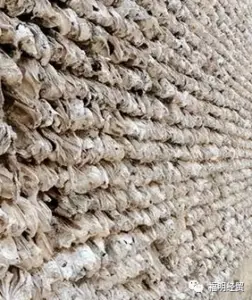
Deep within the ancient town lies the Liuchun Courtyard, where another ancient oyster shell wall comes into view. The high courtyard wall is densely covered with neatly arranged, enormous oyster shells. Due to its age, some shells have darkened, and some show signs of detachment. This oyster shell wall is over 600 years old and is the most classic oyster shell structure in the town. In ancient times, this area was part of the sea, and the coastline was rich in oyster resources. Later, as the coastline expanded, many oysters were buried underground, forming rich oyster deposits. These oyster shells were not buried deep, making harvesting very convenient. Furthermore, our area relies on the sea for sustenance, consuming a large quantity of oysters and generating a large amount of oyster shells. Using local materials, these were perfect for building houses. There are many advantages to using oyster shells for construction. First, oyster shells are hard and make excellent building materials. Oyster shells, with their uneven surface, can be used to build houses and provide security. More importantly, oyster shell houses offer protection against wind erosion, insects, and moisture. They also provide cooling, making them comfortable to live in, warm in winter and cool in summer.
Oysters, also known as mussels, are a well-known and common shellfish worldwide. my country ranks first in the world in oyster farming production, with over 20 varieties found in coastal provinces alone, making them one of the most important economic shellfish in coastal areas. Currently, my country’s oyster development mainly focuses on processing the edible parts. While utilizing the edible parts, a large amount of oyster shells are treated as waste. How to achieve comprehensive utilization of oyster shells has become a research topic of significant environmental and economic importance.
Oyster shells are formed through biomineralization of organic matter, using a small amount of organic macromolecules (proteins, glycoproteins, or polysaccharides) as a framework and calcium carbonate as the unit for molecular manipulation, resulting in a highly ordered multilayered structure. The basic structure of an oyster shell consists of three layers: an outer, extremely thin, hardened protein cuticle; a middle, prismatic layer composed of interwoven calcium fibers in a leaf-like structure with natural gas pores; and an inner, nacreous layer, primarily composed of minerals such as calcium carbonate and a small amount of organic matter.
From a material composition perspective, the oyster shell is divided into inorganic and organic components.
The inorganic component is mainly composed of calcium carbonate, accounting for over 90% of the oyster shell’s mass, with calcium comprising (39.78±0.23)%. It also contains more than 20 trace elements, including copper, iron, zinc, manganese, and strontium. In 1973, the World Health Organization published a list of 14 essential trace elements for the human body, including iron, copper, manganese, zinc, cobalt, molybdenum, chromium, nickel, vanadium, fluorine, selenium, iodine, silicon, and tin. Among these, zinc is crucial for human growth and development, intellectual development, and enhancing immunity. Oysters are among the richest sources of zinc in food, not only in their meat but also in their shells, which contain a high zinc content of (80±1.45) μg/g.
The organic components of oyster shells account for approximately 3%–5% of their mass, containing 17 amino acids, including glycine, cysteine, and methionine. The organic matter in the shell is further divided into soluble and insoluble organic matter, the content of which varies depending on the shell species and growth stage, generally accounting for 0.01%–10% of the shell’s dry weight. Soluble organic matter is even less, accounting for approximately 0.03%–5%.
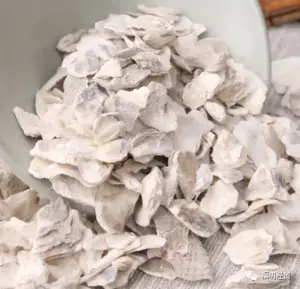
Oyster shells are primarily composed of prismatic layers. Due to their unique leaf-like physical structure, numerous microporous structures of 2–10 μm, and bioactive aminopolysaccharides and characteristic proteins, they can be processed to produce various functional pore structures, giving them strong adsorption capacity, encapsulation function, and catalytic decomposition effects. Therefore, foreign scholars have called them the most attractive biomaterial modifier of the 21st century, with broad application prospects.
The formation of oyster shells bears a high degree of similarity to bone salt deposition in the human body. Studies have found that implanting oyster shells as biomaterials into mice has no adverse reactions, and in vitro experiments have confirmed that treated oyster shells possess good biomaterial activity.
During our investigation into the properties of oyster shells, we were also pleasantly surprised to discover that traditional Chinese medicine texts record the use of oyster shells directly in medicine or after calcination and grinding into powder for medicinal purposes. Further research revealed that oyster shells have calming, sleep-aiding, nourishing, astringent, and nodule-softening effects, and can be used to treat neurasthenia, sleep disorders, anxiety, depression, vertigo syndrome, lymph node tuberculosis, tinnitus, lipomas, and abdominal masses. Oyster shells also have astringent properties, which can be used to treat excessive sweating during the day, excessive sweating after falling asleep, acute and chronic gastritis, and peptic ulcers. The *Qianjin Fang* (Prescriptions Worth a Thousand Gold Powders) states regarding oyster shell powder: “For treating night sweats and headaches due to wind-cold: oyster shell, Atractylodes macrocephala, and Saposhnikovia divaricata, three liang each. Grind into powder, sift, and take one spoonful with wine, twice daily.” The *Haiyao Bencao* (Materia Medica of Marine Drugs) states: “(Calcinated oyster shell) treats male seminal emission, weakness and fatigue, tonifies the kidneys and strengthens the body, stops night sweats, relieves fever and irritability, treats typhoid fever with phlegm, nourishes and calms the mind, and treats infantile convulsions.” These investigations and discoveries further strengthen our confidence and expectations for oyster shells as a material.